Posts

Showing posts with the label memoirs

LIFE on your own terms? WANNABEAT by David Polonoff (Trouser Press)

Image
WANNABEAT by David Polonoff (Trouser Press Books, June 13).   WANNABEAT 's hero in late 1970's San Francisco, Philip Polarov, is on the "make" for women, money, and the elusive zeitgeist of inspiration--the authentic Beatnik poets of countercultural fame. He spots the occasional luminary at City Lights' bookstore (the historic poet's mecca founded by Lawrence Ferlinghetti) and among the burnt-out denizens of North Beach cafes. Yet Philip is not a Beat groupie. He feels the true flame of  purpose and the sting of  Jacques Derrida's Deconstruction Theory ( "the meaning of a work is unstable and could have multiple alternative meanings, so the meaning could easily be the center as it could be the margins..."  ).  Philip could be a player or not.  Desperately, he looks for an impetus to ignite his "stream of drivel" into the work of a  literary contender. Meantime his is the itinerant life of a wannabe artist, chasing down risky and/or ted...

What's a human life Worth? Alice Feiring, TO FALL IN LOVE, DRINK THIS. Rowan Hooper, HOW TO SAVE THE WORLD FOR JUST A TRILLION. Edward Einhorn, IPHIGENIA IN AULIS

Image
Like many pivotal times in human history, say global plagues and wars, when civilizations rise and fall, when there is a question whether humanity will survive, human life is somehow cheapened. Between the rise of gun culture in the U.S. and society's tragic acquiescence, and the sudden devaluation of women's lives, I found myself wondering, "what's a human life worth in these times?  I found a memoir, a "how-to," and a an ancient play translated into a very moving graphic novel. For what it's worth, read on.   I was certainly in the mood for Alice Feiring's coming of age story punctuated by very singular organic wines, To Fall in Love, Drink This: A wine writer's memoir   (Scribner) .   A memoir about learning to drink seemed a gimmick for a wine writer, except this connoisseur's education is like a painter learning his palette.  Her narrative searches for meaning in light-dark encounters with family, lovers, writing and publishers. She finds...

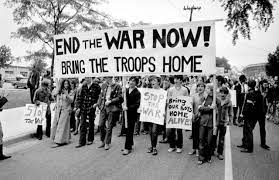
Mid-Century Memoir- "What happened in 1969, when young people tried to remake the world?" Answer PART 2: Activism

Image
  ACTIVISM Part 2 This is a personal essay through the imperfect filter of memory. I began this series, when a friend asked what the year was like,  how was activism organized. Here's the second part of my answer. It was late August 1969, when I arrived at Syracuse University, then a hard-partying campus. I remember rescuing a naive roomate through a window, after she unknowingly drank quaaludes at a raging frat party. But the war was to intrude on such campus fun and games. That fall we freshman went about our business often oblivious to teach-ins on campus. They were also held in public schools sponsored by local business. Unlike rallies, the purpose was educational. Speakers, usually teachers, gave slide shows explaining the history of Vietnam and the French involvement, current politics and rationales for U.S. involvement. Financial and human costs were updated. (Our body counts kept rising, despite the napalm, we made and dropped) At the end of a teach-in, there wa...

EPIPHANY OF A MIDDLE-AGED PILGRIM BY PETER WORTSMAN and KONUNDRUM, When Kafka makes you laugh

Image
  Peter Wortsman is good company; a raconteur known for his short fiction, stage plays, and translations, such as KONUNDRUM, a translation of Kafka that made me laugh. In EPIPHANY OF A MIDDLE-AGED PILGRIM:  essays in lieu of a memoir (Pelekinesis) , he relates   the trepidation of being middle aged, as well as the mysteries of a life half lived. In ( A forword) , he ruminates:  "The only difference between then and now is an accumulation of doubt. But doubt need not necessarily be debilitating. I dedicate these musings to the defining punctuation mark of middle age: the semicolon, a veritable hallmark of uncertainty." Wortsman can make the prosaic terra incognito, such as  First Memory , where a drawbridge and a child's fear of containing "pipi" merge. In  Rough Cuts , there's humorous swagger about the removal of a skin cancer like "a kind of shoot-out at the O.K. Corral." He also creates strangely beautiful moments that are absurd. In Spirit Tre...

Cherches' TRACKS: Memoirs from a Life w/Music (Bamboo Dart Press) and Linda Balliro's BEING A SINGER: The Art, Craft, and Science (Chicago Review Press)

Image
  Peter Cherches, TRACKS: Memoirs From a Life With Music , published by Bamboo Dart Press. I enjoy Peter's prose, from his early Condensed Book t o the more recent Whistler's Mother's Son and Other Curiosities  (Pelekinesis). Publishers Weekly called him "one of the innovators of the short short story" before the term flash fiction. I also enjoyed his amusing and suprising performances at Cornelia Street Cafe with Lee Feldman, crooning standards of his own. Below is an excerpt from TRACKS . Miles Davis, “Straight, No Chaser,” from Milestones (1958)  One of the first jazz albums I bought as an adolescent, I think when I was 12, was Milestones, by the Miles Davis Sextet. I figured I’d kill two jazz birds with one stone: Miles Davis and John Coltrane, neither of whom I’d ever heard, to my knowledge. I was unaware at the time of the more legendary status of the group’s next album, Kind of Blue. I did know that Miles Davis was possibly the most famous living jazz mus...

Is Angelica Huston channeling Colette? Read Vol. 1 of her memoirs, A STORY LATELY TOLD. Can't wait for Vol 2, WATCH ME, in Nov.

As a girl, Angelica Huston's mom would encourage her to read Colette and, of her many influences, this one may have taken root. In her first memoir, A STORY LATELY TOLD: Coming of Age in Ireland, London, and New York (Scribner, Simon & Schuster), there is similarity to Colette in her acute observations; less about what people said, than their experiences and the lives they created. There's also an account of her modelling years that reminded me of Colette's backstage look at the Folies Bergere. Both think they're not really the "type." Colette says she's too self-conscious, a writer performing a pantomime in a music hall. Angelica believe's she not beautiful enough. She had Richard Avedon's word on this. When her parents inquired whether he thought the young Angelica was model material, he'd said her shoulders were too broad. Angelica added a nose that's too large, eyes too small, a look not for conventional beauty. Both Colette an...
Image
F*ck Art (Let's Dance): An Artist’s Memoir by Sally Eckhoff (Water Street Press) Sally Echoff spent ten years, beginning in1977, living on East10 th street in New York's Alphabet City, when this area was a no-man’s land; a mecca for drugs and crime, as well as storefront galleries and punk bands. In F*ck Art (Let’s Dance), she describes her life as an East Village artist, a young woman working to make meaningful art, pay her rent, and be noticed in the “scene,” a creative vortex of talent and desire. With humor and compassion, F*ck Art pays homage to the NewYorkers (locals, natives and transplants), who joined in this ecstatic moment in time.  For along with the improbable rise in prices for East Village art in the go-go 80’s, came inflation of real estate—and the end of the era. F*ck Art (Let’s Dance) began with Echoff's upbringing in a Long Island suburb. Her mother, whose family owned a paint manufacturing business, channeled her talents into homemaking.  Her f...