Posts

Showing posts with the label essays

THE BEGINNING COMES AFTER THE END: Notes on a World of Change by Rebecca Solnit (March 3rd, HAYMARKET books )

Image
The back cover of  The Beginning Comes After the End:  Notes on a world of change calls it   a sequel to  Hope In The Dark.  That book relates the historical moment in 1955, w hen Grace Lee Boggs ushered in the Montgomery Bus Boycott. That event, says Solnit, began the era of progressive social change. Now it may seem eclipsed in a distant past.. What we may not realize in our present world's incessant "newness" is the ageless persistence of social values--old ways and wisdoms. In our rising world view,  interconnection is a core value. Solnit shows how underlying transformations are often obscured by a longer arc of history. The scale of what's underlying is seldom recognized. Yet these currents shape destiny.  In Rebecca Solnit’s new book, The Beginning Comes After the End: Notes on a world of change, there is plenty of evidence for a long view of political change. Though in our current period of backlash, after decades of progressive change, ...

NO STRAIGHT ROAD TAKES YOU THERE: Essays for Uneven Terrain by REBECCA SOLNIT, Haymarket Press

Image
With an economy of space and words, Rebecca Solnit's essays often encompass complex issues not easily defined. Her new book ,  NO STRAIGHT ROAD TAKES YOU THERE :  Essays for Uneven Terrain (Haymarket, 5/13) explores   the organic process of life and change.   The introduction ,  In Praise of the Indirect, the Unpredictable, the Immeasurable, the Slow, and the Subtle , explains the book's intended for "anyone considering history, power, change, and possibility." This is Solnit territory, where you meander through her visions, revisions, and conclusions--which felt "right," though could be a surprise. In "Tortoise at the Mayfly Party, she sums up the approach, "I try to see the long trajectory of events leading to the present moment, because it is this time to see change. To understand change is essential to understanding politics and culture, let alone trying to participate in it. The short view generates incomprehension and ineffectuality. Event...

ON TYRANNY, short and wry lessons from the 20th Century to preserve your liberty. I published this review in 2018. It bears considering again.

Image
"... the precedent set by the Founders demands that we examine history to understand the deep sources of tyranny, and to consider the proper responses to it. Americans today are no wiser than the Europeans who saw democracy yield to facism, Nazism, or communism in the twentieth century. Our one advantage is that we might learn from their experience. Now is a good time to do so." --Tim Snyder "Mr. Snyder is a rising public intellectual unafraid to make bold connections between past and present." --The New York Times This little book of 126 pages succeeds in connecting our time with what went before. In short essays astute, wry and instructive, it lets you know what has happened, where we are and what one person of conscience can do. Here are snippets from Topics.  1. DO NOT OBEY IN ADVANCE Anticipatory obedience is a political tragedy. 2. DEFEND INSTITUTIONS Do not speak of "our institutions" unless you make them yours by action on their beha...

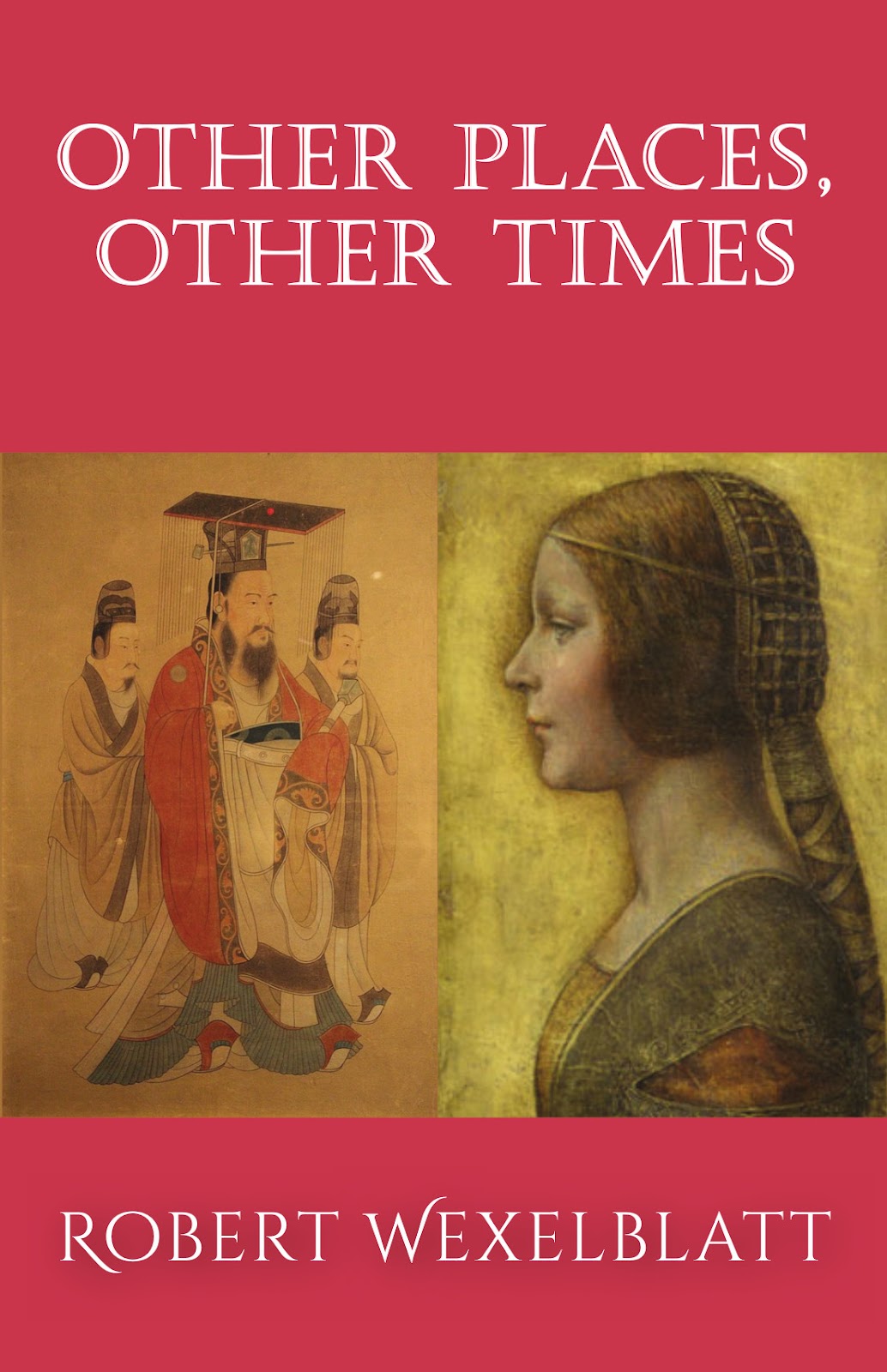
Unexpected surprising books: OTHER PLACES, OTHER TIMES stories by Robert Wexelblatt, NOT TOO LATE, essays edited by Solnit, Lutunatabua, WOMAN ON THE RUN poetry by Carla Sarett, THE PLEASURE PLAN memoir by Laura Zam

Image
Other Places, Other Times by Robert Wexelblatt  (Pelekinesis)  is a collection of twenty-six short historical fictions. Thirteen of the stories are about Chen Hsi-wei, an imaginary peasant-poet of the Sui period, circa 600 C.E. As a boy, he  served the emperor and turned down material rewards for an education. He became a poet (though nobility found an educated peasant as implausible as a flying pig), Hsi-wei travelled the empire making verses, along with straw sandals for customers.  He often set up a sign for sandals in marketplaces, before looking for a corner to sleep in an inn or stable.  Often Hsi-wei's curiosity about people and places led him to incongruous events and mysteries. The poem,  The Madness of Nowa   sums up a strange murder he resolved for a skeptical magistrate. At a seasonal festival, a chance meeting inspired rare insight about time, nature and men. U nknown truths, injustices, fateful sorrow inspired poems.  After some year...

EPIPHANY OF A MIDDLE-AGED PILGRIM BY PETER WORTSMAN and KONUNDRUM, When Kafka makes you laugh

Image
  Peter Wortsman is good company; a raconteur known for his short fiction, stage plays, and translations, such as KONUNDRUM, a translation of Kafka that made me laugh. In EPIPHANY OF A MIDDLE-AGED PILGRIM:  essays in lieu of a memoir (Pelekinesis) , he relates   the trepidation of being middle aged, as well as the mysteries of a life half lived. In ( A forword) , he ruminates:  "The only difference between then and now is an accumulation of doubt. But doubt need not necessarily be debilitating. I dedicate these musings to the defining punctuation mark of middle age: the semicolon, a veritable hallmark of uncertainty." Wortsman can make the prosaic terra incognito, such as  First Memory , where a drawbridge and a child's fear of containing "pipi" merge. In  Rough Cuts , there's humorous swagger about the removal of a skin cancer like "a kind of shoot-out at the O.K. Corral." He also creates strangely beautiful moments that are absurd. In Spirit Tre...

Epiphany of a Middle-Aged Pilgrim by Peter Wortsman: Essays in lieu of a Memoir

Image
Peter Wortsman is good company; a raconteur known for his short fiction, stage plays, and translations, such as KONUNDRUM, a translation of Kafka that made me laugh. In EPIPHANY OF A MIDDLE-AGED PILGRIM: essays in lieu of a memoir , he relates   the trepidation of being middle aged, as well as the mysteries of a life half lived. In ( A forword) , he ruminates:  "The only difference between then and now is an accumulation of doubt. But doubt need not necessarily be debilitating. I dedicate these musings to the defining punctuation mark of middle age: the semicolon, a veritable hallmark of uncertainty." Wortsman can make the prosaic terra incognito, such as  First Memory , where a drawbridge and a child's fear of containing "pipi" merge. In  Rough Cuts , there's humorous swagger about the removal of a skin cancer like "a kind of shoot-out at the O.K. Corral." He also creates strangely beautiful moments that are absurd. In  Spirit Tree , a wild sapl...